

 Malolo Island

| Partner Ministry/Organization | Ministry of Education and Public Service Commission |
| Liaison Officer | Ms. Alison Burchell Permanent Secretary Ministry of Education, Heritage, and Arts Suva, Fiji |
| Recent Programs Held in the Country | 2018: In-Country Program on Quality Assurance System through Results-Based Monitoring and Evaluation Management Systems for TVET Institutions and Educational System (Sep 24-28) 2017: In-Country Program on Generic and Life Skills for Lifelong Teaching and Learning in TVET (May 15-19) 2016: In-Country Program on TVET Capacity Development Programme, organized by TAFE and UNESCO-UNEVOC (May 16-24) 2015: In-Country Program on Industry-Academia Collaborations and Partnerships (Apr 20-24) 2013: (1) Special In-Country Program and National Seminar on Champion Leaders’ Development on TVET Skills for Poverty Alleviation (Dec 2-6); (2) In-Country Program on Web-based Teaching and Learning System in TVET (Apr 22-26) 2012: In-Country Program on Developing E-Learning Contents in TVET (Apr 10-14) |
| Ambassador | N/A |
| Address of Embassy/Consulate in Manila | Fijian Honorary Consulate in Manila, Philippines Executive Offices, JMP Bldg. Jose Cruz St., Brgy. Ugong Pasig City, Manila, Philippines |

| Official Name | Republic of Fiji |
| Land Area | 18,274 km2 (7,056 sq mi) (156th) |
| Population | 909,389(161st) |
| Capital | Suva (pop. 77,366) |
| Largest Cities | Lautoka (est. pop. 52,500) Nadi (est. pop. 42,284) Labasa (est. pop. 27,949) |
| Country Borders | None |
| Religion(s) | Methodist, Roman Catholic, Hinduism |
| Major Languages | English, Fijian, Hindi |
| Demonym | Fijians |
| National Holidays | 10 October 1970 (independence of Fiji from Britain) |
| No. of years of Primary Education | 8 |
| Major Universities | The University of the South Pacific, Fiji National University, The University of Fiji |
| Primary School Enrollment (Total) | 103,160 (2015, UNESCO) |
| Tertiary School Enrollment (Total) | No Data |
| Ministry/ Ministries Supervising Education | Ministry of Education |
| Education as % of GDP | 3.88% (2013, UNESCO) |
| Agency Handling TVET | Ministry of Education, Ministry of Agriculture |
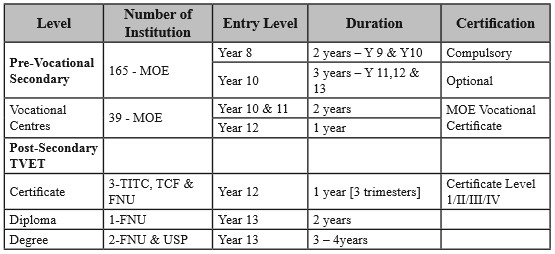
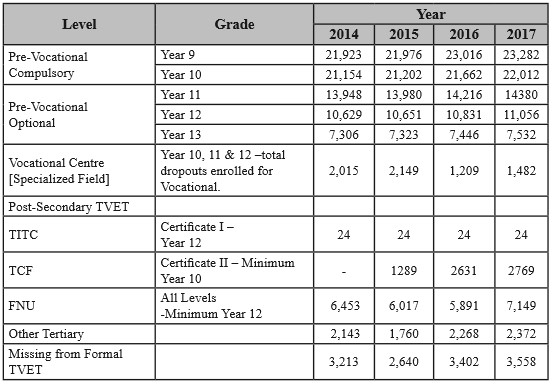
| TVET System of Fiji | Fijian Law ensures all children, without bias, have access to education under the responsibility of the MOE. The government has drawn up educational programs such as the formulation of policies that will cater the needs of the students, raising the quality of relevant education, and making students less dependent on the labor market but capable of venturing into self-employment after completion of their course. School based TVET systems in Fiji are looked after by the Ministry of Education (MOE), both in formal academic and post-secondary levels. The Technical College of Fiji (TCF), with 12 campuses all over Fiji, is a stand-alone technical institution managed by the MOE. Monfort Boys Town, although a private vocational institute, receives annual funding from the MOE. The Fiji National University provides a range of TVET programs such as Agriculture, Engineering, Construction, Tourism & Hospitality, Housekeeping Services & Accommodation, Cookery & Baking, and Forestry among others. These programs are offered at certificate, diploma, and degree levels. The institution is a self-governing body but receives large portion of its annual grant from the Fiji Government. Private TVET institutions like APTECH Computer School, are sectioned under the Ministry of Education for registration and recognition certification. Other private TVET providers with agriculture based-training such as Tutu Vocational Centre are supported and funded by the Ministry of Agriculture. The Ministry of Forestry provides forestry skills training at the Forestry School in Colo-i-Suva named Timber Industry Training Centre (TITC). They also provide short “upskilling” training courses for those already working in the forestry/timber industry. USP’s School of Education provides TVET teachers training programs at the certificate, diploma and degree levels for those who wish to pursue teaching as a career. These programs provide technology-based knowledge rather than industry-based training. USP is managed and funded by 12 Pacific island countries however the Fijian Government contributes a large portion of the USP Fund. The tables below show the structure of Formal TVET (Table 1) and statistics for students enrolled in Formal TVET in 2014 through to 2017 (Table 2). Table 1: Structure of Formal TVET
Table 2: Students Enrolment in Formal TVET
In an effort to promote and improve the image of TVET, the TVET section was renamed Technology & Employment Skills Training (TEST) in 2013, as per the MOE. Also implemented by the MOE is the Skills Training For Employment (STFE) policy, for improved delivery of Technical and Vocational Skills programs in private institutions, non formal training providers, traditional and resource owners, relevant ministries and tertiary institutions to ensure quality standards, recognition and value of the program as an important component of training, human resource development and employment throughout Fiji. The Pacific Regional Initiatives for the Delivery of Basic Education (PRIDE) is a Project jointly funded by the EU and New Zealand to assist the relevant authorities in the improvement of TVET in 15 South Pacific nations, including Fiji. |
| Qualification Framework | The Fiji Qualification Framework is devised by the Fiji Higher Education Commission (FHEC), which operates under the MOE. The FHEC are the primary regulator of quality assurance, national qualification framework, standards, certification, accreditation, acts, policy, funding and training in Fiji. All TVET providers are sanctioned under the commission. The FQF has three (3) key education sectors:
Note. Figure from National Vocational Qualifications and Certifications System of Maldives, by Riyaz. Retrieved from National Vocational Qualification Systems of CPSC Member Countries 2017, CPSC. |
| Levels of NVQS | The Fiji Qualifications Framework (FQF) has 10 levels:
|
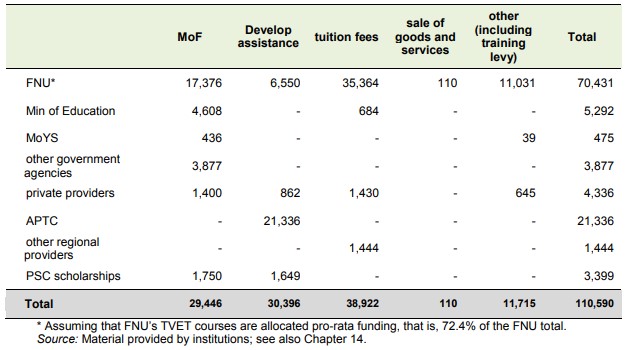
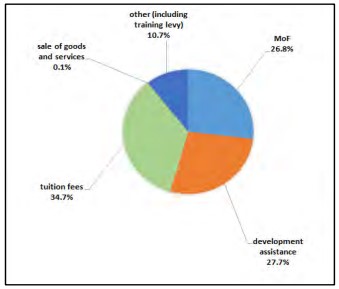
| TVET Financing | Overall the TVET sector draws the majority of its funding from three sources – annual budget allocations from MoF, grant aid-in-kind from development partners, and tuition fees. Table 3. Indicative funding of TVET provision in Fiji, 2012-13 (FJ$ ‘000s)
FNU is by far the largest TVET institution in terms of funding received in Fiji, and is able to draw its funding from a broader range of sources than can other, smaller, national and regional providers. One such source the university can draw on, the national training levy grant scheme. The gross amount annually raised by the university from this source is estimated at around FJ$12 million. Whilst MoE vocational schools can and do charge tuition fees (The only major source of revenue outside of MoF budget allocations and grant aid-in-kind), other line ministry training programs are tuition free, and for them the only sources of finance are the annual MoF allocations. Grant aid-in-kind from Fiji’s development partners comes principally from Australia, mostly in the form of the support given to the Fijian operations of APTC, but also in some scholarship assistance administered through PSC.
Note. Figure from Australian Council for Educational Research by Maglen et al. Retrieved from https://research.acer.edu.au/cgi/viewcontent.cgi?article=1020&context=transitions_misc TVET providers with agriculture based-training such as Tutu Vocational Centre are supported and funded by the Ministry of Agriculture. |

References:
About the PRIDE Project. (2018, January 02). Retrieved August 16, 2018, from https://www.usp.ac.fj/index.php?id=pride_home0
Fiji. (n.d.). Retrieved August 16, 2018, from
http://education.stateuniversity.com/pages/466/Fiji.html
Maglen, L., Wall, M. W., & Manaini, R. (2015). Research into the financing of technical and vocational education and training (TVET) in the Pacific : Fiji : Country report. Retrieved August 20, 2018, from
https://research.acer.edu.au/cgi/viewcontent.cgi?article=1020&context=transitions_misc
Rakona, M. (2017) National Vocational Qualifications and Certifications System of Fiji. In National Vocational Qualification Systems of CPSC Member Countries(pp. 85-98). Manila: CPSC. doi:978-971-8557-98-3
TEST. (n.d.). Retrieved August 16, 2018, from
http://www.education.gov.fj/index.php/g/moe-departments/technical-vocational-education-training
Tuisawau, A. S. (2009). Reorienting TVET Policy Towards Education for Sustainable Development. Retrieved August 16, 2018.

| GDP | $4.556 billion (2015), 152nd |
| GDP Per Capita | $4,926 (2015) |
| Currency | Fijian Dollar (FJD) = 100 cents |
| Major Exports | Agricultural products, fish |
| Major Imports | machinery and transport equipment, petroleum products, food, chemicals |
| Major Industries | sugar, garments, gold, timber, fish, molasses, coconut oil |
| Major Export Partners | US 14.6%, Australia 13.2%, Japan 6.9%, Samoa 5.8%, Tonga 5.1% |
| Major Import Partners | Singapore 32.8%, Australia 15.5%, New Zealand 14.5%, China 10.7% |
| Foreign Exchange Reserves | $963.7 million (2015) |
| Inflation | 3% |
| Population below Poverty Line | 31% |
| Gini Coefficient | 42.8 (moderately unequal) |
| Competitiveness Rank | not reported |
| Ease of Doing Business Rank | 97rd (out of 190) |
| Employment Rate | 93.4% (2013, est.) |
| Unemployment Rate | 7.6% (2013, est.) |
 George Konrote (Fiji Government)
| Type of Government | Unitary parliamentary constitutional republic |
| Head of State | George Konrote (President) |
| Head of Government | Frank Bainimarama (Prime Minister) |
| Legislating Body/Bodies | Parliament of Fiji |
 Image by Paul Harris / Getty Images
| Time zone | UTC + 12:00 |
| Human Development Index | 0.727 (high, 90th out of 180) |
| Literacy Rate | not reported |
| % of people with internet access | 46.33% (413,331) |
| Life Expectancy | 69.72 years (Males: 66.93, Females: 72.89) |
| Drives on the | Left |
| Calling code | +679 |
| ISO 3166 code | FJ |
| Internet TLD | .fj |